


This article was originally published in Dutch in 2014 and has been translated and updated in October 2026.
Content marketing differs fundamentally from existing forms of marketing because it is not aimed at selling. It is not advertising and it is not a commercial. It is not ‘push marketing’. That is why content marketing is sometimes called ‘the marketing of attraction’. The content is so relevant and so tempting that it draws people towards it.
What is content?
The word ‘content’ simply means what something contains. In marketing it is understood as information, substance and interactivity that add value for customers and prospects. Content explains, clarifies and illuminates. Content can take many forms, including:
|
|
What is content marketing?
Content marketing is a form of targeted marketing based on relevant, valuable and appealing offline and online content, with the aim of building new relationships and keeping and strengthening existing ones. It creates connection, interaction, lead generation, reputation (authority), awareness and branding.
How does content marketing work?
As an organisation, you try to share content that touches your prospects and customers so deeply that they start speaking up for you to others. The precondition, of course, is that your product or service delivers on the promise you make, and that your service before and after the sale lives up to expectations. If your customer service solves problems in a friendly, fast and effective way, a spontaneous, happy and positive tweet or review from the customer becomes far more likely. And it is exactly this kind of online content that helps other prospects decide to do business with your organisation.
What does applying content marketing mean in practice?
When you put content marketing into practice, it revolves around the following points:
- Content marketing is not about selling, but about inspiring, engaging and connecting.
- Where traditional marketing draws attention to products and services, content marketing makes your customers and prospects continually smarter and solves their problems.
- You regularly share ideas, suggestions, cases, expertise and experiences, packaged in different forms such as white papers, checklists, apps, step-by-step plans, games, articles, e-books or videos.
- Content marketing is a combination of online and offline activities. Offline content marketing could be, for example, organising a knowledge session for customers or a mini-seminar at a trade fair.

- To reach as many relevant and profitable customers and prospects as possible, and to get them excited about your content, you distribute it through selected ‘paid’ and ‘owned’ media and you encourage ‘earned media’.
- Influencing ‘user-generated content’ as tactically as possible.
- You provide the means to share or respond to online content. For example, you encourage customer reviews by asking for them as part of your email strategy.
- Starting (online) discussions so that prospects and/or customers talk with your organisation, and with each other, about themes, problems and challenges that matter.
- Innovation: through interaction with and feedback from prospects and customers in response to content, discussions and comments, you can improve your services, keep customers and win new ones.
Two types of content
Content marketing involves two types of content: ‘branded content’ and ‘user-generated content’.
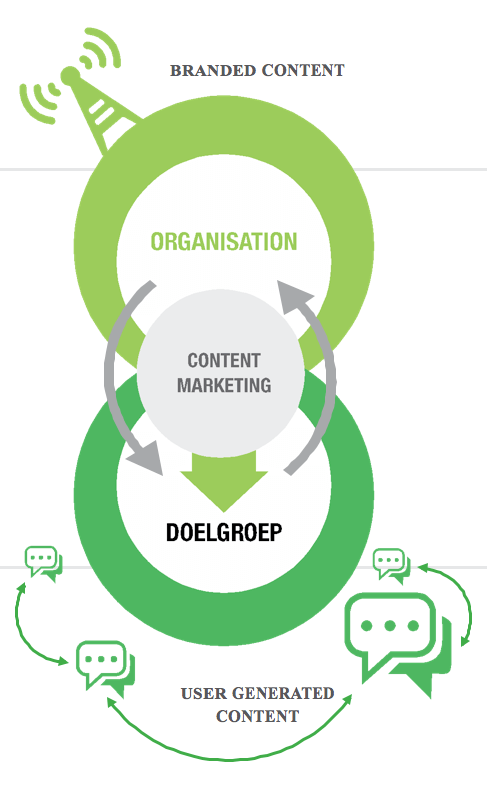
Branded content
Linked to your own organisation, with the brand promise of your organisation incorporated and/or conveyed in it to a greater or lesser extent.
Created by the organisation:
By the marketing and communications department, but also by the rest of the organisation’s employees.
User-generated content
The most important examples are the reviews and recommendations that customers of your service or product leave on, for example, your website, your Facebook page or an independent forum.
Created by the target audience
Comments, questions and input from the target audience, shared with the organisation and/or among members of the audience themselves.
When is content marketing successful?
Content marketing is successful when it results in loyalty and revenue. Loyalty shows itself in, among other things, the number of (actively clicking and sharing) subscribers, followers, likes, retention and shared items. Particularly in B2B settings, content marketing is a form of educational marketing. You learn from it, you learn from each other, and it makes you better at your job.
Pull marketing versus push marketing
As stated earlier, content marketing differs fundamentally from traditional marketing because it does not ‘push’ and is not directly aimed at bringing in sales, but at building and strengthening relationships. Content marketing means being there where prospects and customers need you and are looking for relevant, educational, useful, appealing, engaging and sometimes entertaining information. This content explains, solves problems and attracts without selling.

The value of content
Prospects and customers come to you, rather than the other way around. Because you offer relevant content, share knowledge and mean something to people, the result is an interested, open and receptive follower, prospect or customer. Sharing and giving create a positive attitude among fans, prospects and customers. That makes it an excellent foundation for starting the sales or change process, in both B2B and B2C.