


This article was originally published in Dutch in 2012 and has been translated and updated in October 2026.
The driving force behind the rise of marketing 3.0 is rapid technological change. Smartphones, iPads, laptops, social media such as Twitter, Facebook and YouTube, and collaborative media such as Wikipedia offer unprecedented opportunities for fast interaction between individuals, audiences and organisations. This is the age of ‘participation’. The ‘Marketing 3.0’ model helps you get your organisation ready for this new way of doing business.
Participation
Marketing 2.0, which revolves around meeting customer needs, is no longer enough in an age like this. In marketing 3.0 those needs must of course still be met, but successful organisations will pursue a ‘human-centred’ strategy. They set themselves apart through their norms and values and their ability to let human 3.0 take part in the company’s strategy. A company’s identity and authenticity matter more than ever.Human 3.0 is the new producer
The customer - or rather, human 3.0 - is well informed, uses social networks, forums and blogs, and is more likely to trust fellow customers than companies. Social media has turned consumers into ‘prosumers’. They do not just consume companies’ products and services, they also help produce them. Think of initiatives that already existed at the time of writing, such as NikeID, Lego, BMW ConnectedDrive and Lay’s ‘Maak de Smaak’ (the Dutch edition of its ‘create a flavour’ campaign). Human 3.0 is also your best ‘salesperson’. Enthusiastic customers - ‘super promoters’ - can have a big, positive impact when they talk about your brand on social platforms and encourage others to choose your product or service.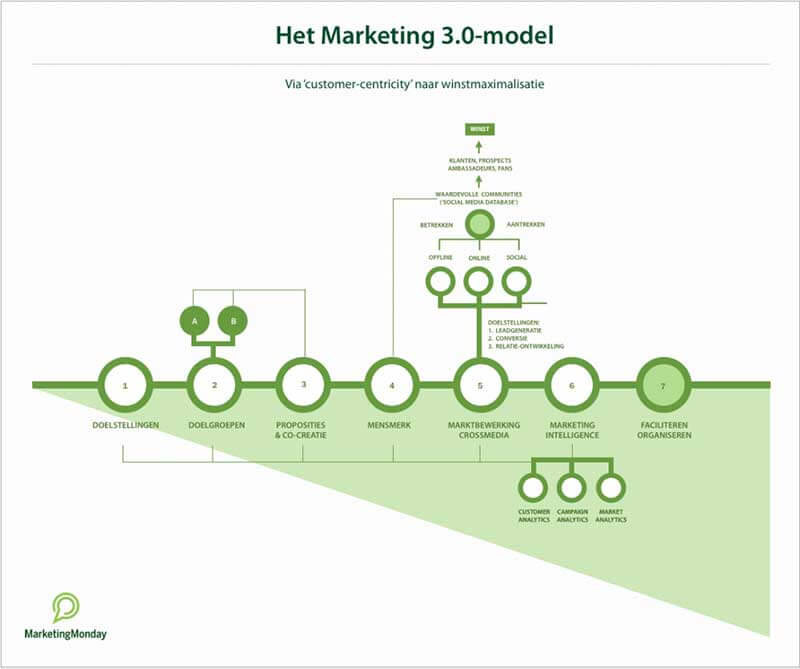
‘The voice of the customer’ resonates in marketing 3.0
MarketingMonday’s ‘Marketing 3.0 model’ is based on the changing media habits of human 3.0 and the call for ‘participation’. ‘The voice of the customer’: customers, prospects, fans and followers are given an important role in the strategy. Use the ‘Marketing 3.0 model’ to test your current strategy and arrive at one in which ‘the voice of the customer’ takes centre stage and customers, prospects, fans and followers make an important contribution.The 7 steps of marketing 3.0
The model takes you through the following steps:
1. Set your objectives
Define commercial objectives that follow from the company’s mission and vision, and enrich them with objectives for new marketing and social media.
2. Define your target groups (‘personas’)
Identify the most promising target groups and gather customer insights: what do they want, how do they think, how do they communicate and through which channels, what are their core values, and what are their demographic and social characteristics? This knowledge is the foundation of your strategy. You cannot be everything to everyone. Decide whom you want to serve, with which product or service, and where your chances of success are greatest.
3. Define your proposition(s) & co-creation
Based on customer insights and ‘the voice of the customer’, develop targeted B2C or B2B propositions. Involve customers in (improving) those propositions through communities on social media or customer panels, for example through co-creation. This lets you build strong, distinctive propositions and extend the customer lifecycle.
4. Be a ‘human brand’
People want to connect with your brand when they can identify with it. What is your identity? What do you stand for as a company? What are your core values? Core values might be ‘quality’, ‘personal’, ‘trust’ or ‘sustainable’, for example. Show who you are and what you deliver, and know how to touch people’s emotions. That way you connect with the customer’s head and heart, and your brand becomes valuable to them. Your identity and core values should come across sincerely and clearly in all your communications and in the actions of your employees. So it is not an act - it is real! This is where social listening and content strategy come in.
5. Cross-media marketing
Based on your knowledge of your audience, your identity and your core values, you can decide which mix of offline, online and social media suits your target group best. Starting from the core values of your company and your audience, you know what binds your target group(s) to your company. With that, you can attract people, engage them and connect them in communities, achieve ‘conversion’ - a request for a quote, an order, a donation - and build a long-term relationship. Working the market is an ongoing process in which the community is fed, retained and grown through a relevant content strategy. Through the community you stay in touch with customers. They provide input into the production process, so you keep delivering the products and services they want. This creates opportunities to extend the customer lifecycle and increase the revenue per customer.
6. Apply marketing intelligence
If you do not know why people choose to do business with your organisation, you have a problem. The more you know about the people you want to attract - the customer insights - the better you can tailor your marketing communications and media to them. Automatically collecting data about your customers is therefore an important way to take results-driven action. Build a CRM system and keep enriching it. Analyse data - customer analytics, campaign analytics, market analytics - about your customers, your campaigns and the market. With the right picture of the customer, the right customer receives the right offer at the right time. You move from ‘mass’ communication to ‘one-to-one’ communication. Use SMART objectives set in advance for each campaign to check whether you are on course or need to adjust.
7. Organise and facilitate
As a company, you need a clear view of your business processes. How can social media (tools) help you optimise internal and external communication and knowledge management? Involve employees from relevant departments when implementing social media. Inspire and motivate employees to get started with social media through internal sessions and explainer videos. Give employees the right resources. If you want to start ‘listening’ to social media, for example, your employees obviously need access to the right listening tools. Connect your marketing intelligence systems to each other (your CRM system with your email campaign software, for instance). Give employees the right knowledge and skills.
Most important of all is that tasks, responsibilities and authority are clearly assigned. Agree with employees on how your company handles social media in a social media policy.
New results with the ‘Marketing 3.0 model’
This new way of working leads to new results, in which loyal customers are retained and new prospects are won. The ‘Marketing 3.0 model’ gives you a foothold for ‘the new way of communicating’ with human 3.0 and for improving your current practices. Use the model together with your own creativity, insights and experience to achieve your goals.