


In short
A good leader in a team with AI agents sets clear intent, decides what to hand to agents and what to keep human, makes it safe to experiment and owns the outcome. That matters more every month: according to Stanford HAI, agents went from 12% to around 66% success on real computer tasks.
An agent has prepared a report, and you have to decide whether it can go to the client. Who checks the work, and who answers for it if there is a mistake? Most lists of leadership qualities were written for teams of people and do not answer that. Below you can read what matters more, what stays the same, and what you can start doing this quarter. In my keynotes I mainly want to influence people’s mindset positively: being open to change, taking action and staying critical about what it delivers.
- In a Nielsen survey for monday.com, 85% of directors and senior managers say a change in skills is required to be a good manager in the age of AI.
- On OSWorld, a test of real computer tasks, agents still fail roughly one in three attempts: good enough to work with, not good enough to trust blindly.
- According to Microsoft, 81% of leaders said in 2025 that they expected agents to be moderately or extensively integrated into their AI strategy within 12 to 18 months.
- Only 26% of AI users say their leadership is clearly and consistently aligned on AI.
- The EU AI literacy obligation has applied since 2 February 2025, with enforcement from 2 August 2026.
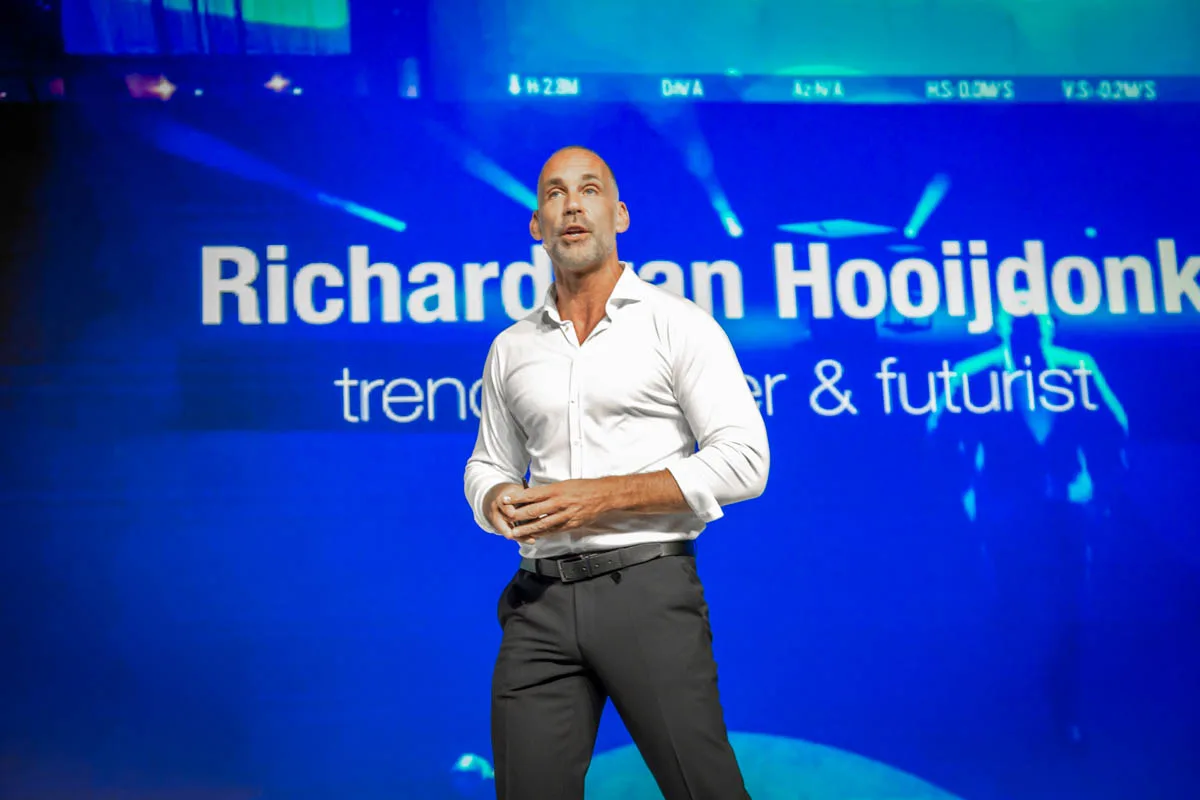
Keynote by Richard
Leadership and Management in the AI Era. Setting direction as AI changes work, making decisions with AI and leading people and AI together.
What changes with agents?
Agents are improving fast, but on the OSWorld test they still fail roughly one in three attempts.
An AI agent does more than answer a question. It takes a goal, plans steps and carries them out: it searches, fills in forms, writes code or handles a customer request. Agents are getting better quickly. According to Stanford HAI’s 2026 AI Index Report, agents went from 12% to around 66% task success on OSWorld, a test of real computer tasks. They still fail roughly one in three attempts. It is one test, but the lesson for leaders is clear: agents can already do a lot, and are not yet good enough to trust blindly.
Organisations are moving anyway. In Microsoft’s 2025 Work Trend Index, 81% of leaders said they expected agents to be moderately or extensively integrated into their company’s AI strategy in the following 12 to 18 months. Microsoft introduced the term “agent boss” for it: someone who builds, delegates to and manages agents. For more on where this is heading, see how autonomous AI will reshape everything you do.
To work with AI and agents, you have to understand how they work: so play and experiment. Leadership becomes managing a combination of people and agents: activating people, giving them the freedom to experiment, and making that possible.
Which qualities matter more?
According to 85% of surveyed managers, being a good manager in the age of AI requires a change in skills.
Managers feel the change themselves. In monday.com’s AI at work 2026 report, a Nielsen survey of 1,701 directors and senior managers in seven countries commissioned by the software company, “85% say a change in skills is required to be a good manager in the age of AI”.
Setting clear intent
When people do the work, a vague brief gets corrected along the way. An agent does exactly what it understood. The 2026 Work Trend Index, a survey of 20,000 AI users in ten countries, describes the new human role as setting clear intent: defining the desired outcome and the quality bar, and designing how the work is shared between humans and AI. In practice, this means a good leader can say in two sentences what “done” looks like, and what “good enough” is not.
Judgement about what to delegate
If an agent fails one in three times on a test like OSWorld, the question is not “can it do this?” but “what happens when it gets it wrong?”. A leader decides where agents can work on their own, where a person checks the result, and where the work stays fully human. That choice depends on the cost of a mistake, not on how impressive the demo was.
Making it safe to experiment
This may be the most underrated quality. In the 2026 Work Trend Index, 45% of AI users said it feels safer to focus on current goals than to redesign work with AI. Only 13% said they are rewarded for reinventing their work with AI, even if the results are not met. Microsoft calls this the Transformation Paradox: people are ready, but the system around them still rewards the old way of working. Managers make the difference. In a study of 1,800 workers cited in the same report, employees whose managers actively modelled AI use reported a 30-point lift in trust in agentic AI. Leaders who use the tools themselves, and say openly what did not work, give their team permission to try.
Alignment at the top
Only 26% of AI users in the 2026 survey say their leadership is clearly and consistently aligned on AI. When the top team sends mixed signals, every manager below makes different choices about agents, data and risk. A good leader makes sure the team knows the rules: which tasks sit with agents, which data can go in and which decisions stay with people. The research lab at SAP SuccessFactors sees the same gap. In related SAP research, 88% of employees say their jobs have changed because of AI, half of those changes without meaningful guidance. And 72% of C-suite leaders say most organisations claiming to transform work with AI are really automating existing jobs faster. The growing role of agents also changes who holds knowledge in an organisation. We wrote about that in the democratisation of expertise.
Owning the outcome
An agent cannot be held accountable. People can. So your organisation has to choose who answers for an agent’s work. A good leader takes on that role, towards customers, colleagues and regulators. Separately, European law asks something of every organisation that uses AI. Under Article 4 of the EU AI Act, organisations that use AI must take measures to support the AI literacy of their staff. The European Commission explains that this obligation has applied since 2 February 2025, and that national authorities supervise and enforce it from 2 August 2026.
What stays the same?
Much more stays the same than the hype suggests; what changes is where the classic traits show up.
Ask people what makes a good leader and the same attributes come back: a clear vision, integrity, empathy, good communication, the courage to decide and the willingness to keep learning. None of these disappear when AI agents join the team. What changes is where they show up.
- Vision
becomes intent that an agent can act on: specific goals, boundaries and what “good” looks like. - Integrity
now includes being open about what was done by people and what by software, and taking responsibility for both. - Empathy
matters more, not less: people worry about their role when agents arrive, and a leader who listens keeps them on board. - Communication
extends to explaining decisions that were prepared by an agent, in plain language. - Decisiveness
means choosing what to automate and what to keep human, instead of leaving that to the tool. - Learning
is no longer optional: leaders who use AI themselves understand its limits and earn more trust from their teams.
People still want a leader who is honest, listens, explains why, and treats them fairly. The traits in our overview of what makes a good leader have not expired. They now have a second audience: the way you design work for agents shows your team what you value. AI can even help leaders do the human part better, for example by taking over routine reporting. That idea is explored in leadership in the age of AI.
How to lead people and agents?
A few practical habits help, from naming an owner for every agent to watching the workload.
For the wider picture, read the six biggest AI leadership trends for 2026. In daily practice, these habits help:
- Name an owner for every agent.
Someone who knows what it does, checks its work and can switch it off. - Agree on a human-agent ratio.
Microsoft’s 2025 report suggests asking two questions: how many agents are needed for which tasks, and how many people are needed to guide them? - Review mistakes openly.
Treat an agent error like any other incident: what happened, why, and what changes. - Measure outcomes, not activity.
An agent can produce a lot. The question is whether the work got better. - Watch the workload.
In the same monday.com survey, “29% say AI has increased their working hours”. Check that time saved does not simply turn into more work. - Treat managing agents as real work.
At Anthropic itself, the company’s own research found that meta-work rose from 10% of employees’ interactive Claude sessions in fall 2025 to 22% in spring 2026, much of that rise due to managing agents: writing specs, having one agent review another, monitoring. That is the company’s own data about its own staff, but it shows that guiding agents becomes a task of its own. - Invest in people first.
In the 2025 Work Trend Index, upskilling the existing workforce (47%) was the top priority for leaders, just ahead of expanding capacity with digital labour (45%).
Richard speaks on this topic
Leadership and Management in the AI Era. Setting direction as AI changes work, making decisions with AI and leading people and AI together.
Frequently asked questions
What makes a good leader now?
The same traits as always, used in a different way: setting clear intent, deciding what to hand to agents, making it safe to experiment, keeping the top team aligned and owning the outcome. On top of that, use AI yourself, so you know what it can and cannot do.
Should a leader use AI personally?
It helps. Leaders who use AI themselves understand its limits and earn more trust from their teams.
Is AI literacy mandatory?
Yes. Under Article 4 of the EU AI Act, organisations that use AI must take measures to support the AI literacy of their staff. That applies to every organisation that uses AI, not only to technology companies.
Will agents take over the leader’s job?
Not the leadership itself. An agent cannot be held accountable; people can. Agents take over steps such as preparing a report, filling in forms or handling a customer request, while deciding what to delegate and answering for the result stay with people.
Where should a leader start?
Start with the work itself, not with a tool, and pick one process to begin with.
AI agents will not be the last new technology your team has to deal with, so what you learn now you will use again later. First list your team’s tasks, from reports and schedules to customer requests, and decide for each one whether an agent can do it or whether it belongs with a person. Then pick one process where an agent could take over a clear, repeatable part of the work. Write down the intent and the quality bar. Name an owner. Tell the team that early mistakes are expected and will be discussed, not punished. Review after a month.
That small step teaches more about leading with agents than any strategy deck. It is also the core of the conversation many leadership teams are now having, and a theme in the keynote on leadership and management in the age of AI.

Richard van Hooijdonk is a trend watcher, futurist and international keynote speaker. Many trend watchers and futurists look at the future from a distance. Richard van Hooijdonk lives in it. His team consists of people and AI agents, and he has several chips implanted in his body. He has given more than 3,000 keynotes in more than 30 countries. View his keynotes →