


This article was originally published in Dutch in 2012 and has been translated and updated in October 2026.
On the rollercoaster between touchpoints, the customer is in the driving seat. They don’t follow a straight path, but find their information through many different channels: online, in the shop, on TV, in the newspaper, at birthday parties and weddings, in a sales conversation and on social media. Organisations want to reach the right prospects at the right moment to influence their decision. But when exactly is the right moment?
There is a lot of talk about the new ‘customer empowerment’ during the sales process and the importance of customer experience. The 4V sales process model sets out the different phases within the sales process.
The 4V sales phase model versus the Customer Decision Journey
In broad terms, the B2C and B2B sales processes follow the same course. In B2C, the consumer may never have personal contact with the selling organisation (think of online sales), whereas in B2B this is usually unthinkable. In B2B, an organisation’s employees play an important role as touchpoints in the decision-making process (from the sales department to customer service). Once you have closed ‘the deal’, the ‘selling’ doesn’t stop, and your (after) sales and marketing activities need to be in order. After all, you want loyal customers who think of you again for their next purchase. This raises the value of each customer. Your loyal customers also recommend your brand to other prospects, so that they may include your brand as a purchasing option in their own initial orientation.
In this context, it is interesting to compare McKinsey’s model, the Customer Decision Journey (CDJ), with the 4V sales process.
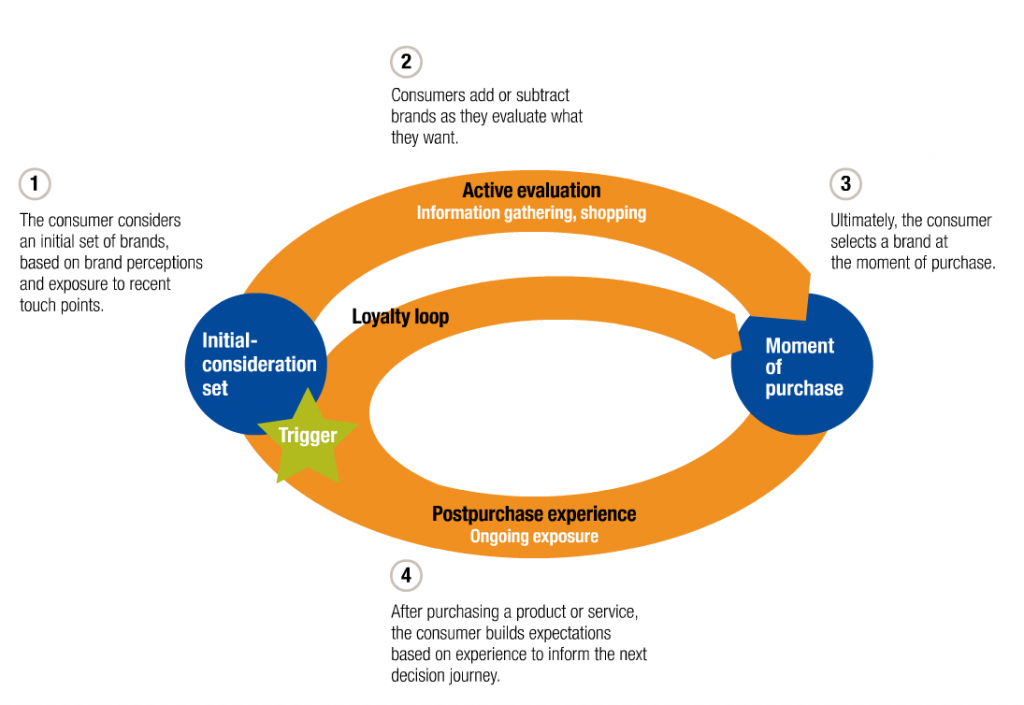
Source: McKinsey
In the purchasing process, you want to influence prospects by offering the right information or stimulus at the right moment. The 4V sales phase model is a sales funnel that guides the customer from orientation to (repeat) purchase, while the McKinsey model shows the important role that touchpoints play along the way.
Tempting customers: awareness
In the ‘Tempt’ phase, you as an organisation raise awareness of your product or service through online and offline advertising, direct mail campaigns, in-store promotions and your sales staff, among other things. This is how you work towards being top of mind when prospects first consider a product or service. Touchpoints are the places where the prospect can be found: in the shop, in the online store, on the corporate website, in online magazines or on social media, for example.
Winning customers:
influence the customer with your customer contact strategy
In the ‘Win’ phase, you want to persuade the customer to make a purchase. This phase is crucial. Many organisations focus on awareness, but it is precisely in this research phase, as customers gather information during their ‘journey’, that they are highly receptive to information from organisations offering comparable products and services. In this phase, the prospect can be won over by customer contact moments via email, phone, the website or in the shop (friendly, fast service and strong arguments). The effect of other customers sharing their experiences of products and services they have bought, however, is enormous! In this phase, the prospect readily drops brands from their shortlist and adds new ones.
Retaining customers: optimise your customer contact moments after purchase
In the ‘Retain’ phase, you want to build a lasting bond with the customer and turn them into an ambassador. In this phase, the customer is using the product or service. The deal is done, but as a company you are not finished. You stay in touch with your customer, and above all you want to encourage your active, loyal customers to share their experiences, because these are hugely valuable in the Win phase. Call customers after they have bought a product or service to ask what they think of it, and/or routinely ask them to leave a review through an email campaign. Involve them in developing new features of your product or service. The customer contact moments after purchase are part of the Customer Decision Journey towards a repeat purchase and/or contract renewal. Make sure your after-sales service exceeds expectations and that, when problems arise, the right questions are asked so you can give the customer good advice. This can even prompt the customer to expand the services they use. Collect information about your target group in your database so you can create relevant contact moments: birthdays, new additions to the family, house moves, year-end, important events and so on.
Increasing customer value: positive buzz from loyal customers
In the ‘Increase’ phase, you want to raise customer value. With existing customers, you can do this by extending the positive experience after purchase: keep giving them attention, involve them in product development, share new knowledge and give them sound advice. This makes the customer more inclined to buy additional products and services. By staying in touch with customers, you are also more likely to tempt them into a repeat purchase when a new ‘consider’ and ‘evaluate’ phase comes along.
In addition, total customer value rises because loyal customers share their experiences and create positive buzz on social media and online forums. As a result, prospects gain confidence in your brand and become convinced that they should buy.
Setting up a customer contact strategy
For (B2B) companies, setting up a customer contact strategy is about the contact moments (touchpoints) that the company itself can influence or initiate. You cannot steer a conversation at a networking drinks event, but you can shape every moment a prospect or customer visits your website, speaks to your sales representative and/or calls customer service. You also want to know which online sources (from online magazines to comparison sites) prospects consult while orientating themselves. To a certain extent, you can then make sure you are present there.
Defining touchpoints
Within a customer contact strategy, we define touchpoints as contact moments that can be influenced within one phase of the customer decision journey and that lead to the next phase of the customer decision journey, or in other words, the sales process.
The path to a customer contact strategy
To optimise your customer contact strategy within the customer decision journey, we look closely at the use of various (social) media, online marketing and the communication flows between the company’s employees and the prospect or customer. To arrive at a renewed customer contact strategy, you first need to map out the current situation.
* Gain insight into your current and/or desired target group. What are their ‘pains’ and ‘pleasures’? Which themes are relevant to them? What information do they need in their decision-making process? How does the competition approach this?
* What are the current, important contact moments between the customer and the organisation (or its product information)? What information is exchanged, and where?
* How can the current contact moments be improved and/or expanded for each sales phase?
* Draw up a new customer contact strategy that includes, among other things, descriptions of the social personas you are targeting, the contact moments your organisation can actively influence, and the information to be exchanged at each contact moment (based on customer insights, relevant themes and your content strategy).
Conclusion
You cannot influence all the information a prospect or customer takes in. But by being present at the moments where you do have a say, you can increase your influence on their decision-making process. Content strategy plays an important part here: sharing knowledge in the Tempt and Win phases helps you build awareness and thought leadership. The experiences customers share with each other after a purchase are extremely valuable. They are ‘social proof’ and help to build trust among prospects. Customers’ experiences and suggestions are also of great value to your organisation in continuously improving your products and services.
A good customer contact strategy ensures consistent, ongoing attention for the customer, which will result in greater customer satisfaction, more sales and more positive (online) buzz.