


This article was originally published in Dutch in 2012 and has been translated and updated in October 2026.
When we are busy working towards our company’s goals, there is one thing we should never forget: who are we actually doing it for? Answer that question properly with one or more social personas, and it can boost your company’s revenue.
The success of a business depends on how well your service or product matches the needs and core values of your target audience. Social media give you the chance to get to know your customers better and to involve them in ‘their’ service or product. Every now and then, pausing to think about your audience and asking yourself a few questions often leads to illuminating insights. A good way to map and understand your target groups, and to decide on the right customer contact and content strategy, is to translate those groups into one or more social personas. I’d like to share the steps you go through to do this.
1. Look at your current audience base
We are going to segment the audience: divide it into groups. There are various criteria you can use for this. You can segment according to ‘traditional’ characteristics, such as:
* Demographic: age, income, region, household composition, life stage, etc. (e.g. male/female, young/older people, single/married).
* Socio-economic: education, income, job role (e.g. vocational/higher education/university, average/above-average income).
* Geographic: country, region, city, neighbourhood, etc. (e.g. the Netherlands/Belgium/Europe, urban/rural).
You can also use other kinds of segmentation criteria and models:
* Psychographic segmentation: segmentation based on behaviour that cannot be predicted from the characteristics above. It is behaviour that shows itself under certain circumstances (e.g. personality traits such as extraversion or honesty, and lifestyle).
* Behavioural segmentation: dividing the market on the basis of how people relate to a product, such as loyalty, frequency of use, willingness to buy, purpose of use, amount of use and the moment of use (e.g. light, medium and heavy users).
Segmentation models
Models you can use include, for example:
* The Mosaic model: a system developed by Professor Richard Webber that divides consumers into types and groups based on shared demographic, psychological and lifestyle characteristics, linked to geographic characteristics (right down to postcode and house number).
* The Cross Cultural Consumer Characterisation (4Cs) model: this model from advertising agency Young & Rubicam distinguishes seven types of people based on their motivations, rooted in ‘Security, Status, Individuality, Freedom, Survival and Escape’.
* The Mentality model: this model from the Dutch research agency Motivaction groups people according to their outlook on life. At the time of writing it distinguished eight social milieus. Each social milieu has its own values, lifestyle and consumption pattern, which shows itself in concrete behaviour.
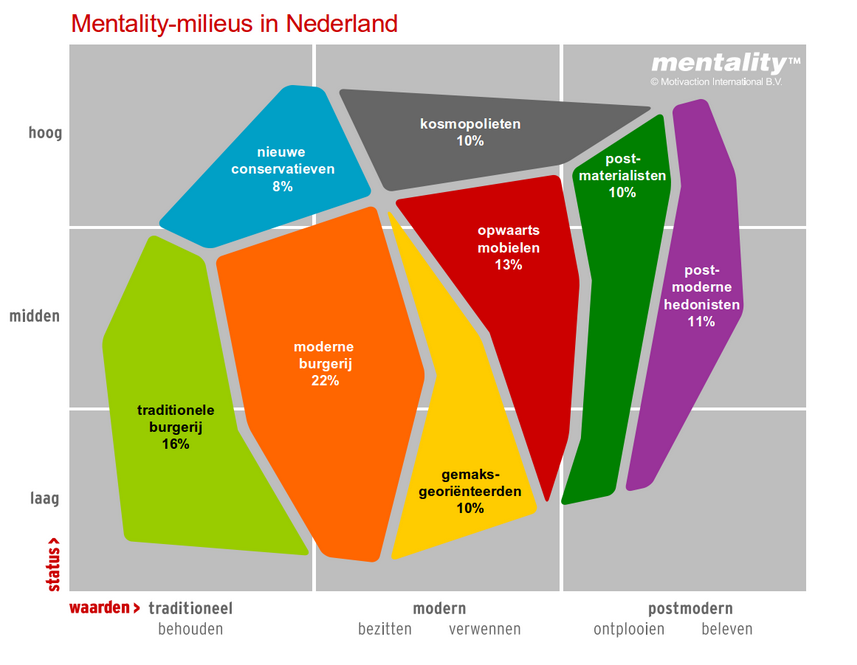
By gaining insight into the values and behavioural patterns of your audience, you can make your services and your marketing communication a better fit, so that your message really touches them and prompts them to act (whether that means sharing a message on social media or making an actual purchase).
Segmentation gives us the opportunity to focus on specific target groups. Clearly, the target groups of your business share certain expectations of your product or service.
Segmentation is an important first step in drawing up and carrying out your customer contact and communication strategy.
2. Find out which audience offers the most potential
Because our product or service cannot be everything to everyone, we choose specific target groups and tailor our strategy to their particular characteristics.
To make that choice, ask yourself which target group adds the most value in helping you reach your (profit) goals. Besides this group, are there other groups to discover, sometimes called aspirational target groups? Are these existing groups, or should we be thinking ‘outside the box’?
Try to focus on ‘growth audiences’. By this I mean groups that have enough potential to grow, but that are also large enough in volume. Researching your competitors may give you extra insight when deciding where to focus. It can also be smart to look at what similar companies abroad are doing.
Another interesting question to think about: is there an opportunity to serve the B2B market from the B2C market with a version of your current proposition, adapted or not? Or the other way round?
3. Audience chosen? Now list the customer insights
Customer insights tell you more about the motivations and needs of your audience. To arrive at good insights, we need to list the so-called ‘pains’ and ‘pleasures’. These are the explicit needs or problems that have to be met or solved.
You can uncover these insights in several ways, for example:
* interviews with your target audience
* a customer panel
* surveys
* existing research, including quantitative research
* user-generated opinions (testimonials, opinions, online reviews)
* interviews with employees who are in contact with customers
* information from business systems (CRM) and social media
Brainstorm about the target groups with stakeholders inside the company. Draw on the experience and knowledge of different departments (for instance customer service, sales and marketing for customer insights, and product development and IT for innovative and practical possibilities).
Try to discover patterns in the research data. As far as possible, look at what customers do rather than what they say. That way you can adapt your product or service to what they actually use!
During the brainstorm, come up with at least 10 ‘pains’ and ‘pleasures’ per target group in the areas of product development, marketing communication and web presence.
4. Select the most relevant customer insights
During the brainstorming session you will create a sizeable list of customer insights. Select the most relevant ones. In other words: insights you can really do something with in terms of product development, branding, marketing communication and/or web presence. Insights that help you serve your audience (even) better, and that let you spend your energy and time on the product development and communication activities that contribute most to reaching your goals.
Conclusion
Defining social personas enables you and your team to make quick and sound decisions. The benefits of a social persona:
* A social persona (or several) gives everyone in the organisation a clear focus: everyone shares the same picture of ‘the customer’. This prevents unnecessary discussions.
* Thanks to that focus, time is spent only (or mainly) on the target groups and customer wishes that matter. You can set priorities.
* A shared focus and a shared picture of the customer lead to consistent, effective communication and product development, resulting in better service.
* Personas help you better understand customers and their wishes, needs and complaints.
* When you know your persona’s behaviour and patterns, you develop something they will use, rather than something they ask for!
Because the team focuses clearly on the right matters and activities, revenue will rise. And as I said earlier: you will see that you and your team can make faster and better decisions, because there are no more discussions about ‘who the customer is’ and what ‘the customer wants’.
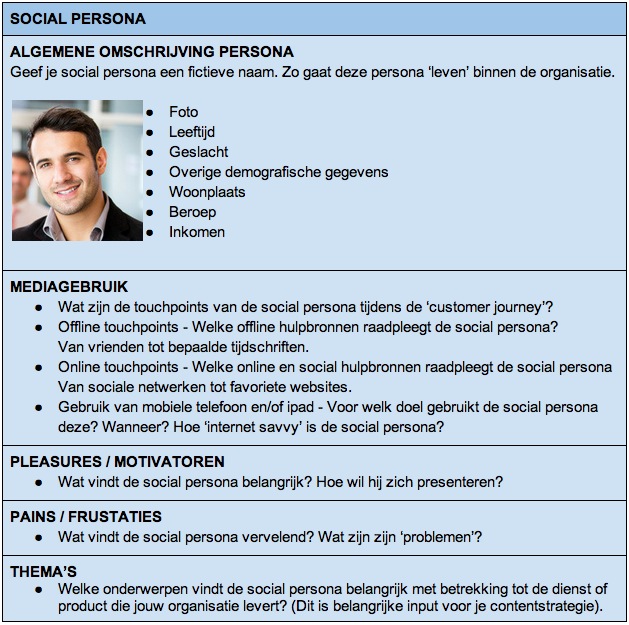
Example template for creating a social persona (in Dutch)