


This article was originally published in Dutch in 2016 and has been translated and updated in October 2026.
- How important are drones in construction?
- Drones are becoming the new construction supervisors
- Any lazy builders on your team? Drones will pick them out in no time
- Expectations for drones in construction are sky-high
- Thanks to drones, we are already seeing improvements in the key aspects of construction
- Drone surveillance makes construction sites safer
Technology can revolutionise traditional processes in the blink of an eye, and over the centuries it has lifted humanity into a highly advanced species. Every day we see how smart technology, the Internet of Things and data-driven innovation are guiding us towards an era of sustainability, intelligence, connectivity and global prosperity.
The technologies popping up everywhere today are completely transforming sectors such as healthcare, transport, construction and the automotive industry. Among these new technologies, drones deserve a special mention, especially when you see how they are revolutionising several sectors at once. Drone technology helps farmers achieve higher crop yields through advanced crop monitoring, for example. In 2016, Amazon was already testing drones to deliver its products faster and more cheaply. Governments in various countries were using drones for street surveillance, and in the military, drones were helping to improve border security around the world.
The sector that, at the time of writing, had most recently been transformed by drone technology is construction. In this post we will look at why drones are intrinsically important for making construction projects more profitable, and how they help property companies generate more revenue by cutting labour and production costs. Do you have unproductive workers on your construction site? The drones will track them down for you! Let’s take a closer look at how drones are set to change construction all over the world.
How important are drones in construction?
Findings published around 2016 by industry sources such as Construction Global suggested that drones can be valuable to the construction sector. They offer substantial upgrades for many applications in the industry. Drones are ideal for carrying out aerial site surveys, for example. They can be used to inspect construction sites and carry out important assessments, such as dimensions and height and access restrictions. For owners and managers of construction companies, deploying drones translates into considerable savings in time and resources.
Because drones can be fitted with HD cameras, they can take real-time measurements while capturing photos and video at the same time. Using helicopters for traditional aerial photography is extremely expensive compared with the low cost of using drones. Drones can also be deployed for virtual surveillance to prevent break-ins, vandalism and accidents.
Drones can help with energy management too. With drone technology, the lighting on construction sites can easily be monitored, for example, keeping energy waste to a minimum. When it comes to construction logistics, the possible applications of drones are almost endless. We already know that Amazon has been experimenting with drones to deliver its products, and construction companies are increasingly applying this technology as well. Using drones for heavy lifting and other tasks could significantly reduce the costs of traditional construction transport, which is becoming a motivating factor for more and more construction companies to adopt drone technology.
Drones are becoming the new construction supervisors
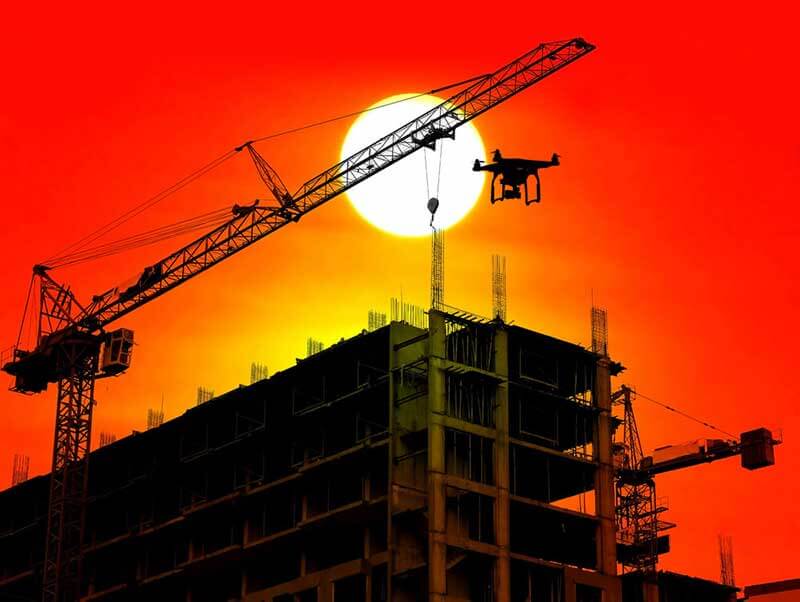
In an experiment by students at the University of Illinois around 2016, drones equipped with cameras were used to monitor work on construction sites through aerial surveillance. Using crowdsourcing, the various activities of workers were reviewed and calculations were made of how much time was spent on particular tasks. While it is easy to picture the benefits of implementing such a concept, experts also believe that a scenario like this could have negative consequences for workers’ privacy. On the other hand, monitoring construction workers is nothing new, which makes it considerably more likely that this new concept will be accepted.
Drone technology is being adopted in construction rapidly and on an ever larger scale. This is down to the wide availability of the hardware and its falling cost. Sophisticated controls, simple navigation and easy-to-use software make this technology very attractive. Large-scale use of drones in construction could well be the answer to the industry lagging behind other sectors. According to a report by the National Research Council of the National Academies, published in 2009, the core of this problem lies in planning, coordination and communication in construction. At the time of writing, the construction of the Sacramento Kings’ new stadium in California was being monitored by drones. The software sends alerts when progress on the building work falls behind schedule and identifies areas that need attention to get things back on track. I think construction companies will increasingly put their trust in drone technologies in the future, and realise that adopting drones can make the construction sector more efficient, faster and more profitable.
Any lazy builders on your team? Drones will pick them out in no time!
To build on our Sacramento Kings stadium example: the project used surveillance drones with advanced cameras supplied by ImageInFlight. The surveillance footage collected by these cameras is converted into 3D images, which in turn are fed into software developed by the team at the University of Illinois. The resulting data gives construction managers detailed insight into how the work is progressing. It does this by identifying the areas where construction is behind schedule, and by spotting the builders responsible for the delays. The developers at ImageInFlight are aware that these new technologies can be unsettling because of their privacy implications. Then again, workers are already monitored by CCTV, and other surveillance technology is already used in construction. I do think these high-tech surveillance techniques should be introduced with care, so that workers do not have to worry about their privacy being violated.
Expectations for drones in construction are sky-high, but what can they really do?
Komatsu, at the time the world’s third-largest manufacturer of construction machinery, launched a new initiative called SmartConstruction in 2015. Its machines are fitted with simple iMC (intelligent Machine Control) technologies, which make complex training for workers unnecessary. That in turn reduces costs for contractors and managers. The software will also allow less skilled workers to operate the drones easily. SmartConstruction planned to use drones to scan construction sites in real time and create 3D projections. Deploying these drones would lower the cost of current aerial surveillance and inspection techniques and bring greater efficiency to construction activities.
The video above by Federico Augugliaro shows how strong structures can be built with flying machines such as drones. A drone can autonomously tie a rope around two supporting joints, and once these are in place, surface structures can be attached to them. The video also shows how automated technology lets you program several drones at once so they can work together on other construction processes.
If these applications can be tailored for large-scale implementation, profit margins will rise exponentially! At the moment, these drones can only be used to build tensile structures, because their capabilities are limited to tying knots. But the potential is limitless. In the future we may well see bridges being built with drone technology. Now that is advanced technology!
Thanks to drones, we are already seeing improvements in the key aspects of construction
Drones are already being accepted as faster and safer alternatives to traditional on-site monitoring methods. Take the Patricia and Phillip Frost Museum of Science project in Miami, for example. At the time of writing it was being built by Danis Building Construction Company, and the site was teeming with drones constantly keeping an eye on the progress of various aspects of the build.
In fact, drones give these companies a way to improve the quality of their buildings, and completion rates are many times higher thanks to increased efficiency and better site surveys. We have already seen how Komatsu uses drones to make its construction projects cheaper, more efficient and more profitable. There are also huge improvements in management and communication, thanks to direct connectivity in which data analysis and the related estimates are generated instantly. This allows engineers and managers to make their processes faster, more efficient and more accurate.
Experiments by construction firms such as AECOM, Bechtel and DPR Construction have already demonstrated the many benefits of drones in construction. They use drones to take aerial photographs and monitor activity on site. Engineers can collaborate remotely and generate detailed insights based on data-driven analysis and statistics. The expression ‘bird’s-eye view’ is increasingly being replaced by ‘drone’s-eye view’. Drones have the potential to cut working hours as well as the costs of surveillance, analysis and construction cost estimation, all important aspects of construction.
Drone surveillance makes construction sites safer
If you have a few smart devices keeping an eye on your house from the air, you don’t need to worry about your security. In construction, that would be done by entire fleets of ‘security drones’. Drones are already used in construction to prevent accidents and monitor worker productivity. They are also becoming increasingly important in security, where they are mainly deployed to prevent crimes such as arson and vandalism. Drones are also used to monitor construction progress and to reach areas that are difficult to access.
Bechtel and Skycatch were already using drone tech to make their sites safer. There, drones are also used to collect real-time environmental data, such as air quality and temperature, to make the construction site safer. Some areas can be hazardous because of difficult terrain or other environmental factors, and drones can help determine the safest ways to carry out construction work in such areas.
Transporting building materials and machinery becomes easier with drones, because they can lift heavy materials without the high costs associated with some current and former technologies. They can be used to keep track of incoming and outgoing building materials and products, or to replace lorries when building materials need to be moved across hard-to-reach or inaccessible areas. Moreover, delivery times could be cut by more than 50% because the efficiency of these drones does not depend on things like traffic delays. It is clear that drones play an important role in safety and efficiency across every aspect of construction. At the time of writing, US Customs and Border Protection was also already using them to monitor the borders of the United States.
Another example is the German Octocopter. This drone was developed by researcher Christian Eschmann (Fraunhofer Institute for Nondestructive Testing IZFP) and is used to monitor the condition of buildings. With the drone helicopter, travel times no longer have to be taken into account, and there is less danger to staff in dilapidated buildings or hazardous areas. We can clearly see that drone technology has a great many positive effects on the overall safety of a construction project.
Conclusion
There is no doubt about it: drones are completely changing construction sectors all over the world. Every aspect of construction, such as site monitoring, communication and analysis, labour productivity, the transport of goods and safety, can be innovated by implementing drones and related technologies. In the future we will see companies such as Komatsu, where fleets of drones complete complex construction projects in record time and at lower cost. Octocopters make sure it is safe for a construction team to work in and around a building. High-definition 3D imaging will allow drones to produce projections and cost estimates in real time, so engineers and managers can make better decisions at any time of day, from any location. Of course, there are questions about the violation of workers’ privacy, but I am convinced that the benefits of these technologies will help people see the bigger picture, so that, in my view, the future of the construction sector will be accepted and embraced without too many problems.
In the future, huge fleets of drones will be inextricably linked to this new construction interface. They will make sure everything is under control: surveillance and security of construction sites, finding relevant data, transporting building materials and safeguarding worker safety. Drones will allow engineers and managers to make accurate decisions remotely. Work will become more efficient, and lower costs will lead to bigger markets and higher profits. In a nutshell, with the help of drones, the construction sector, like most other sectors, will be transformed forever.