


In short
You don’t choose an AI keynote speaker on name, but on what your audience should do differently afterwards. Knowledge is often the bottleneck: according to Eurostat, 70.9% of EU enterprises that had considered AI but did not use it cited a lack of relevant expertise. Ask eight questions in advance, covering goal, audience, sector examples and fees.
You are organising a conference, a staff event or a kick-off, perhaps with guests from several countries, and you need a speaker on AI. Online you mostly find lists of names, but they do not tell you whether someone fits your goal and your audience. So you won’t find a “top 10 AI speakers” here, but you will find the questions you can put to any speaker or speaker bureau.
- According to Eurostat, almost 20% of EU enterprises with ten or more employees used AI in 2025, up from 13.5% a year earlier.
- Among large EU enterprises, 55% used AI in 2025, according to Eurostat.
- The AI literacy obligation in the EU AI Act has applied since 2 February 2025, with enforcement from 2 August 2026.
- Only 26% of AI users say their leadership is clearly and consistently aligned on AI.
- AI agents went from 12% to around 66% task success on OSWorld: the technology moves fast, and a talk on AI can age quickly.
Keynote by Richard
The AI Revolution. What AI can do today and where the next ten years could take it: what it means for work, organisations and society.
Why book a session on AI now?
More and more companies use AI, many get stuck on knowledge, and the law asks for AI literacy.
Use is growing fast. According to Eurostat, almost 20% of EU enterprises with ten or more employees used AI in 2025, up from 13.5% a year earlier. Among large enterprises, the share was 55%. At the same time, many companies get stuck on knowledge. Of the EU enterprises that had considered AI but did not use it, 70.9% named a lack of relevant expertise as a reason, ahead of a lack of clarity about the legal consequences.
There is a legal reason as well. Article 4 of the EU AI Act asks organisations that use AI to support the AI literacy of their staff. That obligation has applied since 2 February 2025, and national market surveillance authorities supervise and enforce it from 2 August 2026, according to the European Commission.
After a good AI session, the audience knows what the next step in AI will be: which unexpected possibilities and major opportunities are coming, and how organisations, roles and jobs can adapt. Ethics and risks are part of it too, so people can make sound decisions; that makes the session a good starting point for an AI-first strategy.
Which 8 questions do you ask?
Eight questions help you choose, from the goal and the audience to the fee.
These questions are specific to AI. A general checklist for any speaker is in Hire the perfect speaker, and what a keynote speaker is and does in Keynote speaker: a person who delivers value.
1. What should people do differently?
Start with the goal, not the speaker. Do you want people to feel confident trying AI? Do you want the leadership team to make a decision on AI agents? Or do you want clients to see your organisation as forward-looking? Each goal calls for a different story. Write it down in one sentence and share that sentence with every candidate.
2. Who is there, and what do they know?
A room full of executives needs something different from a company-wide event for 500 people from every level and several countries. Knowledge levels differ too. In Microsoft’s 2026 Work Trend Index, a survey across ten markets including France, Germany, Italy, the Netherlands and the UK, only 26% of AI users say their leadership is clearly and consistently aligned on AI. A good speaker will ask about your audience first, before promising a story. Also pay attention to what goes unsaid. Many employees already use AI but would rather not admit it. We wrote about that earlier in How to handle AI shame.
3. Inspiration, explanation or both?
An inspiring keynote opens eyes and gives energy. A more practical session explains how something works and what people can do tomorrow. Most organisers want a mix, but the balance varies. Ask the speaker what that balance looks like for your goal, and ask for a clip that shows it.
4. How current is the talk?
With AI, a talk can age quickly, because the technology moves fast. One example: according to the 2026 AI Index Report from Stanford HAI, AI agents went from 12% to around 66% task success on OSWorld, a test with real computer tasks. Agents still fail roughly one in three attempts. A speaker who talked about chatbots last year should be telling a different story now. So ask: when was the talk last updated, and which examples come from the last six months? A keynote on agentic AI, for example, should show what agents can and cannot do today, not what they promised a year ago.
5. Examples from your sector?
AI in healthcare is different from AI in logistics or education. Eurostat shows that use varies strongly by sector: in 2025, enterprises in information and communication led the way. An audience recognises itself more easily in examples from its own world. Ask which sector examples the speaker uses, and whether they are adapted after a briefing call.
6. Room for interaction and questions?
Questions from the audience are often the most useful part of an AI session, because people can voice their own doubts. Agree how much time there is for them, whether there is a moderator and whether questions can also be sent in advance or through an app. With a large audience, the latter often works better.
7. Which language, and live or online?
At a corporate event in Europe, the audience often comes from several countries. English is the usual choice, but sometimes part of the programme works better in the local language. Ask whether the speaker is equally strong in the languages you need, and whether interpretation or subtitles are an option. Also decide on the format: on location, online or hybrid, and how long. Length, language and format belong on every keynote page, so you can compare candidates easily; one example is this keynote page on the AI revolution.
8. What does an AI keynote speaker cost?
There is no fixed price. The fee usually depends on the length of the session, the location and travel time, online or live, the amount of tailoring and how well known the speaker is. Always ask what is included: a briefing call, adaptation to your sector, a Q&A afterwards or a recording. Then compare not just the fee, but also what you get for it.
A keynote as AI literacy?
A keynote is mainly a starting point: workshops, agreements on use and practice follow after that.
A keynote can help, but on its own it is rarely enough. The European Commission writes that there is no one-size-fits-all approach to AI literacy, and no certificate is needed. Organisations tailor their approach to the knowledge of their staff, the context and the risks of the AI systems they use. They can keep an internal record of trainings and other guiding initiatives. A keynote sparks curiosity and gives people a shared language. Workshops, agreements on use and practice in their own work follow after that, for example by checking in each department which tasks AI can do and which stay with people. Feel free to ask a speaker how the session fits into such a programme.
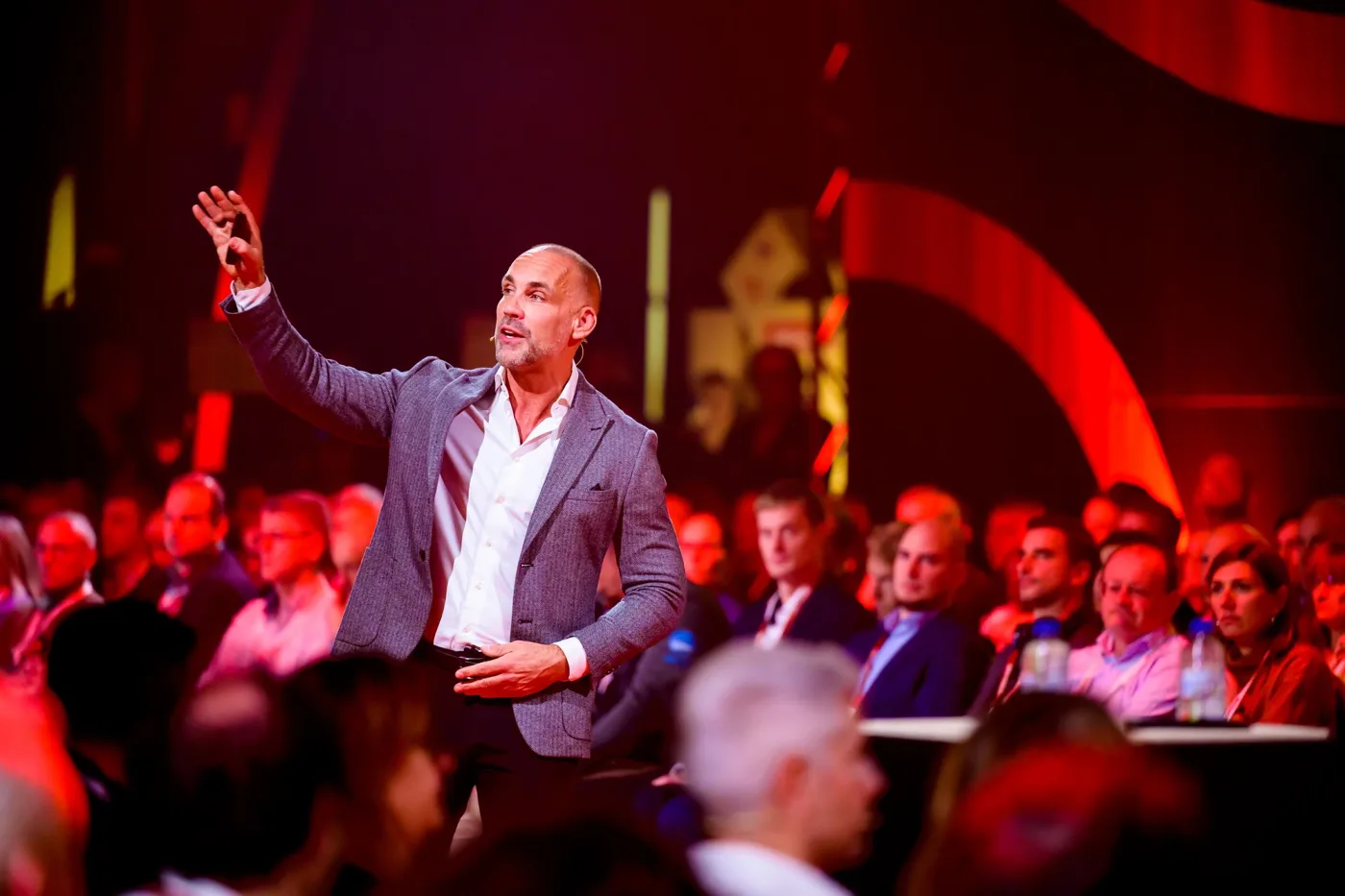
How do you check a speaker?
Watch a recent clip, ask for a reference and schedule a short briefing call.
- Watch a recent clip, preferably from the last few months, not a showreel from years ago.
- Ask for a reference
from an organiser with a similar audience or sector. Reviews on a speaker’s website help with a first selection, but a conversation with an organiser tells you more. - Schedule a short briefing call.
Does the speaker ask about your audience and goal, or start talking about their own story right away? - If you ask an AI assistant to compare speakers, check its sources.
ChatGPT and similar assistants often draw on lists and profiles from speaker bureaus, and those can be out of date: old talks, old figures. Check what you take from them against the speaker’s own website. - Read what the speaker writes.
Articles and newsletters show how current and careful someone’s work is. - Look at stage quality.
In that clip, look not only at the content, but also at whether the speaker holds the room: pace, examples that suit your audience and room for questions. - Ask for an option in good time.
If you have a preference, ask for an option on your date before you work out the briefing; that way you know right away whether the speaker is available.
What goes into the briefing?
Put the goal, the audience, the programme and what you want to measure in the briefing.
A good briefing makes every speaker better. Include the goal in one sentence, who is in the room, what is on the programme before and after the session, which questions are on people’s minds, which examples are sensitive and what you want to measure afterwards. What a guest speaker can add to an event, and so what you may ask of the session, is described in The impact of a guest speaker. If you want the audience to look beyond AI alone, mention that too. Think of the broader developments in five mega trends that will reshape business in the next decade.
Richard speaks on this topic
The AI Revolution. What AI can do today and where the next ten years could take it: what it means for work, organisations and society.
Frequently asked questions
Is AI training mandatory?
No fixed format is required. Article 4 of the EU AI Act does ask organisations that use AI to support the AI literacy of their staff. According to the European Commission, there is no one-size-fits-all approach and no certificate is needed; you tailor the approach to your people’s knowledge and the risks of your AI systems.
Is one keynote enough?
Usually not. A keynote sparks curiosity and gives people a shared language. Workshops, agreements on use and practice in everyday work should follow, for example by checking per department which tasks AI can do and which stay with people.
How many companies already use AI?
According to Eurostat, almost 20% of EU enterprises with ten or more employees used AI in 2025, up from 13.5% a year earlier. Among large enterprises, the share was 55%.
Can you compare speakers with ChatGPT?
You can, but check the sources. AI assistants often draw on lists and profiles from speaker bureaus, and those can be out of date. Check what you take from them against the speaker’s own website.
To sum up
Choose on goal and audience, and see a keynote as the start of the conversation.
Choose an AI keynote speaker based on your goal and your audience. Ask how current the talk is, whether the examples come from your sector and how much room there is for questions. Compare fees on what is included. And see a keynote as the start of the conversation about AI in your organisation, not the end point. For transparency: this blog belongs to a keynote speaker on AI. If you want to compare his offer with other candidates for an international event, AI keynote speaker for events in Europe puts language, format, fee and booking in one place.

Richard van Hooijdonk is a trend watcher, futurist and international keynote speaker. Many trend watchers and futurists look at the future from a distance. Richard van Hooijdonk lives in it. His team consists of people and AI agents, and he has several chips implanted in his body. He has given more than 3,000 keynotes in more than 30 countries. View his keynotes →